


ENS compliance
Conformity with the ENS is achieved through a continuous improvement process structured in three phases: adequacy, implementation and audit. The following are the steps of each phase and how compliance is demonstrated by system category.
ENS alignment and compliance stages
ENS compliance is organised into three phases (alignment, implementation and audit) within a continuous improvement cycle. The diagram below summarises the activities in each phase and the CCN tools that support them.
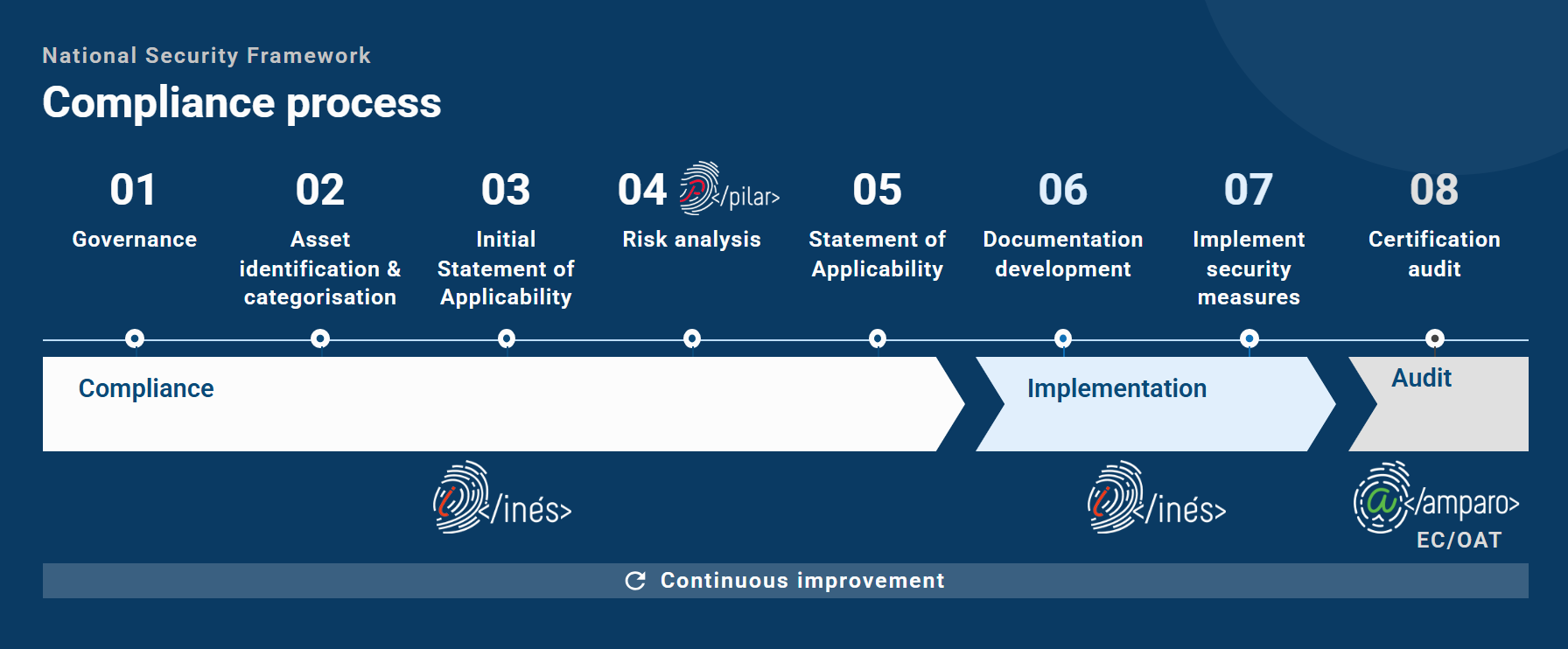
Detailed diagram description
National Security Framework
- Governance
Alignment · INES
- Asset identification and categorization
Alignment · INES
- Declaration of initial applicability
Alignment · INES
- Risk analysis
Alignment · INES · PILAR
- Declaration of applicability
Alignment · INES
- Documentation development
Implementation · INES
- Implement security measures
Implementation · INES
- Certification audit
Audit · AMPARO · EC/OAT
Continuous improvement
Stage 1 · ENS alignment
This stage defines the governance model, scope and system security category, conducts the risk analysis and prepares the Statement of Applicability. INES facilitates each of these tasks.
Appointment of the Information, Service, Security and System Officers, establishment of the Information Security Committee and approval of the Security Policy.
Decide which systems are within scope and identify the information and services they handle. Assess the impact that an incident would have on each of them across the five security dimensions. The dimension with the highest level determines the system category: BASIC, MEDIUM or HIGH.
Specific Compliance Profile (PCE) reference
If a Specific Compliance Profile (PCE) exists for the sector or type of entity, it may be used as a starting point because it includes security measures selected for that sector’s usual systems.
Using the category and the levels of each dimension established in the previous step, select the security measures and mandatory reinforcements applicable to the system from Annex II. Some measures depend on the category and others on the level of a specific dimension or group of security dimensions. INES generates this list using the data from step 2.
Threats to the system are identified, and the risk remaining after applying the initial Statement of Applicability’s security measures is assessed. If unacceptable to the entity, the risk must be reduced through additional measures, reinforcements or compensating measures, recorded in the final Statement of Applicability.
Recommended toolPILAR Web
The web version of PILAR, the CCN’s risk analysis and management tool.
The initial Statement of Applicability is reviewed in light of the risk analysis results. This review may require:
- reinforcing a measure beyond the requirements of the category,
- replacing a measure with another that provides equivalent or greater protection (a compensating measure), with the corresponding documented justification, or
- justifying why a measure is not applicable.
The final residual risk is the risk remaining after applying this final Statement of Applicability.
The Security Officer approves the final version.
Outsourcing services does not transfer responsibility
The contracting of an external service, such as that of a cloud provider, transfers the operational responsibility and not the liability: compliance with the system remains the responsibility of the contracting entity. The supplier must be verified to comply with the ENS for the service provided.

At the end of this stage, the approved final Statement of Applicability is available; its security measures are those to be put into effect during implementation.
Phase 2 · Implementation
This phase involves the implementation of security measures and documentation of their application, starting with the Final Applicability Declaration drawn up in Phase 1, and work can continue with INES assistance.
The security documentation framework is developed: Information Security Policy, security regulations, procedures, technical instructions and records.
The security measures set out in the final Statement of Applicability are implemented. Security products and services included in the CPSTIC Catalogue may be used for this purpose, and staff may receive training through the ÁNGELES platform. In addition, organisations within the scope of the ENS must complete the INES questionnaire through INES.
With security measures in place, the next step is to demonstrate the system’s conformity with the ENS (stage 3).
Stage 3 · ENS audit
This stage demonstrates that the system meets ENS requirements through a Declaration of Conformity or Certification of Conformity, depending on its security category.
Ways to demonstrate compliance
A system complies with the ENS when it applies the security measures required for its category and set out in its Statement of Applicability. Compliance is demonstrated through one of these two routes:
Declaration of Compliance
CategoryBASICFor BASIC-category systems, compliance may be demonstrated through a Declaration of Conformity. This is based on a self-assessment by the entity itself, without an independent external audit, checking that the system implements the security measures in its final Statement of Applicability and that evidence is available to verify compliance. After passing the self-assessment, the entity issues the Declaration of Conformity and obtains the corresponding compliance mark. Certification is also possible for the BASIC category: it is voluntary but recommended, and may be mandatory if a contract or public procurement procedure requires it. See how to obtain Certification of Conformity.
Certification of Compliance
CategoryBASICMEDIUMHIGHFor MEDIUM- and HIGH-category systems, conformity must be demonstrated through a Certification of Conformity. This is based on an independent external audit by an ENAC-accredited certification body or an OAT, with guarantees of independence, impartiality and professionalism. The audit verifies that the system implements the security measures in its Statement of Applicability and that evidence is available to verify compliance. If the audit is successful, the certification body issues the Certification of Conformity and the corresponding compliance mark, which may be used only while the certification remains valid.


According to the system's category
BASIC | MEDIUM | HIGH | |
|---|---|---|---|
| Type of assessment | Self-assessment or certification | Certification | Certification |
| Carried out by | The organisation itself, or a certification body or OAT | Certification body or OAT | Certification body or OAT |
| Compliance mark | Declaration or Certificate of Conformity | Certificate of Conformity | Certificate of Conformity |
| Tools |  Self-assessment  Certification | Certification | Certification |
| Cycle | 2 years | 2 years | 2 years |
INES
A tool supporting alignment, implementation, self-assessment and the issue of a Declaration of Compliance.
AMPARO
A tool for formal audits and Certification of Compliance, used by accredited certification bodies and OATs.
Certification of Compliance
Certification requirements
Certification demonstrates, through an external and independent audit, that the system applies the security measures required by the ENS for its category. Before applying, the entity must have addressed the following:
Scope of the certified system
The systems, services, information and premises covered by certification. The certificate is valid only for that scope.
System category and Statement of Applicability
The category (BASIC, MEDIUM or HIGH) and the list of applicable security measures, signed by the Security Officer.
Implementation of Annex II security measures
The security measures in the Statement of Applicability must be implemented and effective, with evidence that they work.
Documentary, technical and organisational evidence
Policies, rules, procedures, records and configurations demonstrating that each measure is applied.
Managing non-conformities and corrective actions
A procedure for recording non-compliances, implementing corrective actions and verifying their effectiveness, documented in a corrective action plan.
Continuous improvement cycle
Periodic review of risks, security measures and incidents to maintain and improve the level of system security.


How to obtain Certification of Conformity
The audit may be carried out by an ENAC-accredited certification body or, for public-sector organisations, by an Órgano de Auditoría Técnica (OAT) recognised by the CCN and with authority over the organisation. The audit’s scope and timetable are agreed with the selected body.
The documentation and evidence demonstrating the implementation of security measures are collected.
The certification body or OAT audits the system within the agreed scope. The outcome may be favourable, favourable with non-conformities or unfavourable (see “Audit outcomes”).
Certification of Compliance is valid for two years and is published in the ENS certificate register.
Certification is renewed through a regular audit at least every two years. During its validity:
- Any substantial change to the system or the certified scope must be reported to the certification body or OAT.
- If that change may affect the required security measures:
- within six months of the last audit, an extraordinary audit is conducted, reviewing only what has changed;
- after those six months, a full regular audit of the system is conducted.
- An extension of certification is only possible in exceptional cases and provided that neither the system nor the scope changes. The two-year period may be extended by up to three months due to force majeure beyond the control of the organisation and its certification body or OAT, which verifies the cause and sends the request to the CCN (CoCENS report IC-01/19).
Audit outcomes
At the end of the audit, the certification body or OAT issues a report with its opinion on the system’s compliance with the ENS. There are three possible outcomes:
Favourable
The system meets the requirements of the ENS for its category in accordance with the Declaration of Applicability. The certification body or OAT shall issue the Certificate of Conformity, valid for two years, and the entity shall obtain the corresponding badge.
Favourable with non-conformities
The audit has identified deficiencies which do not prevent certification but must be corrected The entity shall submit a Corrective Action Plan (CAP) within one month. If the certification body or OAT accepts it, it shall issue the Certificate of Conformity If it is not submitted or accepted, it may be subjected within six months to an extraordinary audit of all the deviations detected without a new CAP.
Unfavourable
The system has deficiencies that prevent it from being certified, so the Certificate of Conformity is not issued. The entity may correct those deficiencies and request an extraordinary audit to review only those deficiencies within six months of receipt of the report. After that audit, a corrective action plan cannot be submitted: either all deviations are overcome or the certificate cannot be issued.


Compliance Marks
Following the Declaration or Certification of Compliance, the organisation obtains a mark publicising the system’s compliance with the ENS. Public-sector organisations must publish it on their electronic office, in accordance with Royal Decree 311/2022.
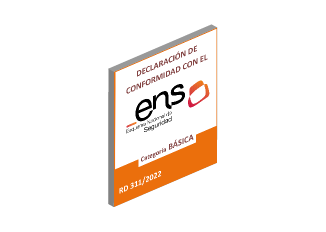
Declaration of Compliance mark
CategoryBASICFor BASIC-category systems whose compliance is demonstrated through self-assessment.
- Who obtains it
- The organisation itself, after issuing the Declaration of Compliance.
- Validity
- Two years, until the next self-assessment.
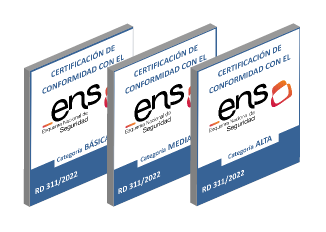
Certification of Compliance mark
CategoryBASICMEDIUMHIGHFor systems with Certification of Compliance issued by an accredited certification body or an OAT.
- Who obtains it
- The audited organisation, after obtaining Certification of Compliance.
- Validity
- Two years.
How to use it
Obtain the mark
The mark is obtained with the document demonstrating compliance. For a Declaration of Compliance, the organisation prepares the declaration and the mark in accordance with the models in CCN-STIC guide 809. For Certification of Compliance, the mark accompanies the certification issued by the accredited certification body or OAT following the audit. In both cases, the mark must link to the supporting document.
Publish it on your organisation's website
Public-sector organisations must publish the mark on their electronic office, in accordance with article 38 of Royal Decree 311/2022. Private-sector operators may display it on their website to publicise their compliance with the ENS.
Keep it current
The mark remains valid for as long as the supporting Declaration or Certification of Compliance is valid. On renewal, it is replaced with the updated mark, and the previous declaration remains accessible on the electronic office.
The conformity mark templates are provided in guide CCN-STIC 809, available in the guide catalogue (800 series). The validity of a Certification of Conformity can be checked in the register of ENS Certificates.
ENS compliance requires continuous improvement: regular review of risks, security measures, evidence and incidents, and renewal of the Declaration or Certification of Compliance within the prescribed periods.