


ENS certification
Register of valid Conformity Certificates, certification bodies, Technical Audit Bodies (OAT) and the ENS Certification Council (CoCENS).
ENS conformity certificates
The register lists valid ENS Conformity Certificates.
The steps to obtain the Certificate of Conformity are described in Compliance › How to become certified.
Certification bodies and OATs
ENS conformity audits and certification may be carried out by ENAC-accredited certification bodies and, in the public sector, Technical Audit Bodies (OAT) recognised by the CCN. Both appear in a single listing showing their accreditation or recognition status.

Certification bodies
These are private entities accredited by the National Accreditation Body (ENAC) under UNE-EN ISO/IEC 17065. They may audit systems in any security category, in both public and private sectors, and issue ENS Conformity Certificates.
Limited-distribution systems
For systems classified as LIMITED DISTRIBUTION (DL) or equivalent, an organisation must be accredited by ENAC within the scope of the National Security Framework, in accordance with UNE-EN ISO/IEC 17065:2012, to certify compliance with STIC requirements. Security audit organisations must also hold a valid Facility Security Clearance (HSEM).
Compliance with STIC requirements for classified systems (DL) may also be certified by audit organisations meeting one of the following options (CCN-STIC-101):
Accreditation as a certification body
The accreditation as a Certification Body shall be granted by ENAC, at the request of the entity concerned.


What is an OAT?
A Technical Audit Body (OAT) is a public sector body recognised by the CCN, under guide CCN-STIC 122, to conduct ENS security audits within its scope of authority. Unlike a certification body, it is not accredited by ENAC: it is recognised by the CCN, which issues a Recognition Certificate verifiable through its electronic office. An OAT is more than a team with ENS knowledge: it must have a structure, independence, competent personnel, a documented methodology and evidence to support conformity audits.
What does it do?
What should not be confused
Technical Audit Bodies (OAT) mailbox
Contact
You can write about
Bodies wishing to become OATs: requests for the recognition session, questions about the process and submission of documentation. Recognised OATs: communications about audits carried out and renewal of recognition.
Recognition as an OAT
Requirements the body must demonstrate, process steps and necessary documentation.
CoCENS
The ENS Certification Council (CoCENS) is a collegiate body which incorporates stakeholders and contributes to the proper implementation of the ENS. It meets at least once a year to address the needs arising from its mission
Powers and duties
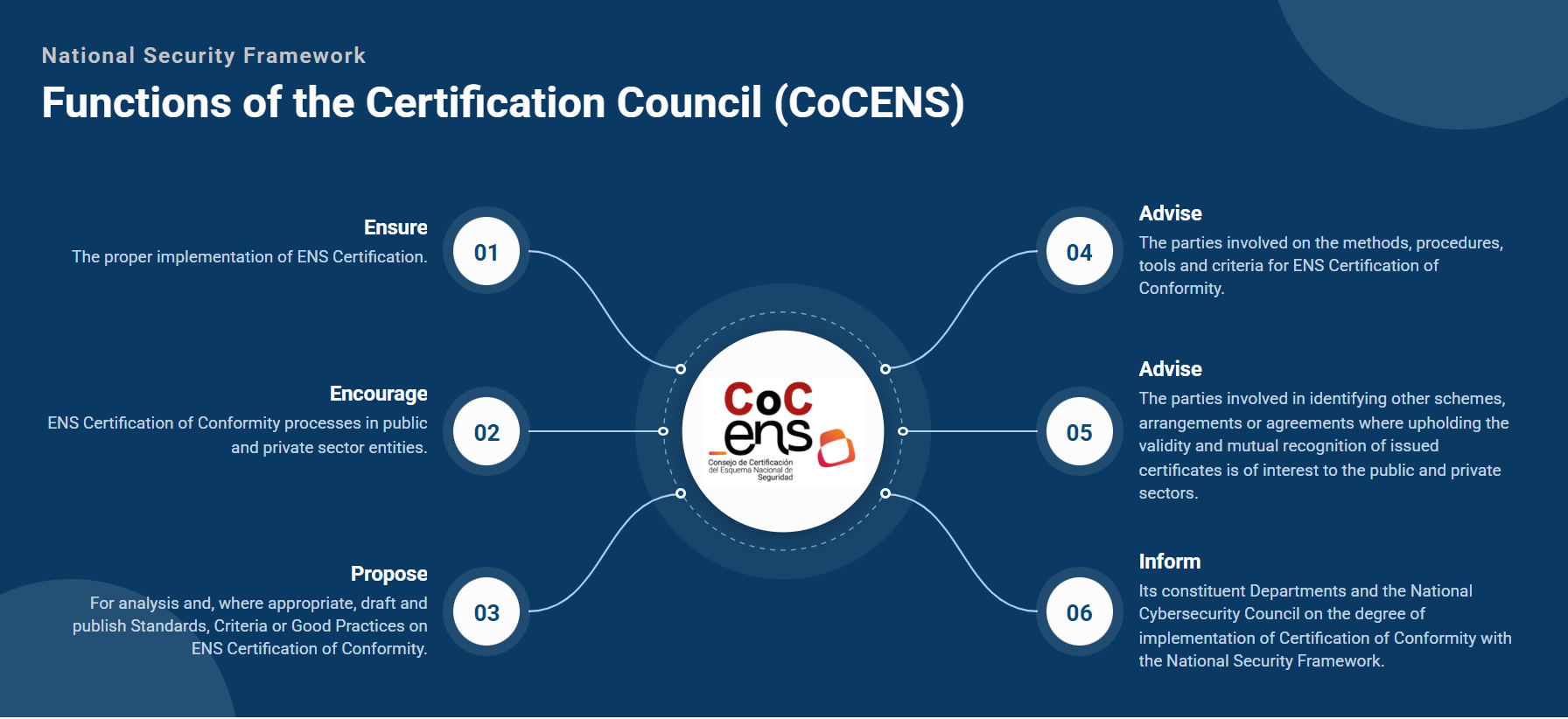
Detailed diagram description
National Security Framework
- Ensure
For the proper implementation of ENS certification.
- Encourage
The process of ENS Conformity Certification in public and private sector entities.
- Propose
For the purposes of their analysis and, where appropriate, for drafting and publishing Standards, Criteria or Good Practices on ENS Conformity Certification.
- Advise
To the parties involved, regarding methods, procedures, tools and criteria for ENS Certification of Conformity.
- Advise
To parties involved in the identification of other schemes, arrangements or agreements where defence of the validity and mutual recognition of certificates issued is of interest to the public and private sectors.
- Inform
To its constituent departments and the National Cybersecurity Council, on the degree of implementation of National Security Framework Certification of Conformity.
Permanent members
Non-permanent members
The actors or members of CoCENS are defined in guide CCN-STIC 809.
Its role alongside the CCN

CCN
Responsible for the technical and operational management of the certification scheme.

CoCENS
Coordination, consensus and development of common certification criteria

