


Steps to create a Technical Audit Body (OAT)
The creation of an OAT requires the organisation of internal decision-making, the definition of its area of competence, the implementation of its own management system and the recognition by the CCN.
What an OAT must be able to demonstrate
Minimum capabilities that must be demonstrable through documentation and in practice.
Scope of authority
The organisation must be clear about which systems, services or organisations fall within its scope and why it has the authority to audit them.
Technical capability
The OAT needs personnel with sufficient experience, training and knowledge of information systems auditing and the ENS.
Impartiality and confidentiality
The OAT shall manage conflicts of interest, ensure confidentiality, keep records and demonstrate during the recognition session how it applies its procedures.


Steps to become an OAT
The CCN-STIC 122 guideline structures recognition as a sequence of application, verification, recognition session, accompanying audits and grant or refusal of recognition.
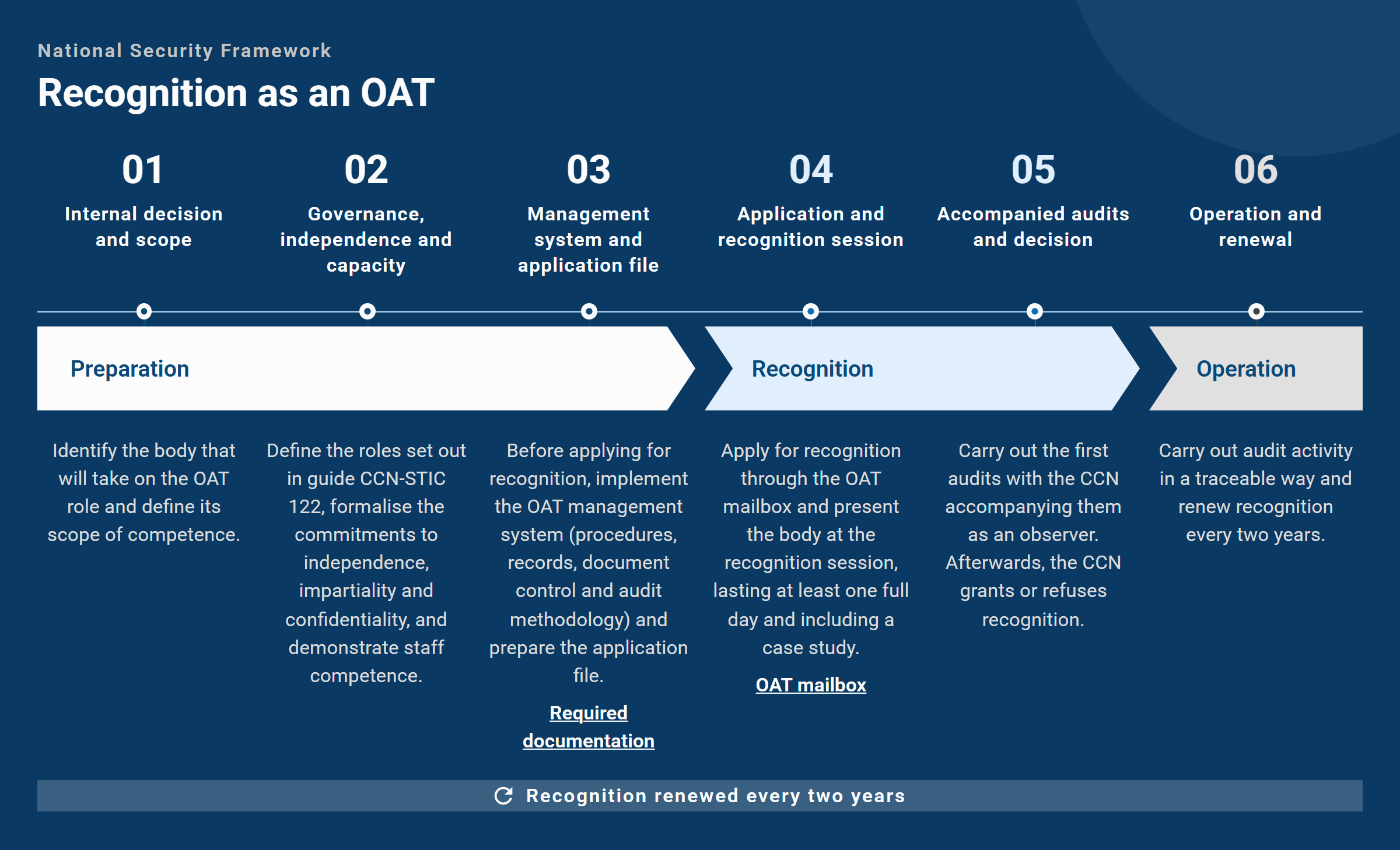
Detailed diagram description
National Security Framework
- Internal decision and scope (Preparation)
Identify the body which will assume the role of OAT and define its scope of competence.
- Governance, independence and capability (Preparation)
Defining the roles of CCN-STIC Guide 122, formalising commitments to independence, impartiality and confidentiality, and certifying staff competence.
- Management system and file (Preparation)
Implement the management system of the OAT (procedures, records, documentary control and audit methodology) before applying for recognition and prepare the file.
Necessary documentation - Application and recognition session (Recognition)
Request recognition by mail to the OAT and present the body at the recognition session, which is at least one day long, including a practical case.
Technical Audit Bodies (OAT) mailbox - Accompanying audits and decision (Recognition)
Carry out the first audits with the CCN accompanying them as an observer. Afterwards, the CCN grants or refuses recognition.
- Operation and renewal (Operation)
Develop audit activity in a traceable manner and renew recognition every two years
Recognition renewed every two years
Recommended documentation file
The dossier shall demonstrate technical, organisational and operational capacity to carry out ENS audits and maintain recognition.
Governance, structure and policy
Impartiality and confidentiality
Audit and certification process
Decision, follow-up and evidence
Relations with auditees and the CCN
Training, monitoring and control

Technical Audit Bodies (OAT) mailbox
RACI matrix of the OAT recognition process
| Process stages | OAT | OAT audit staff | CCN |
|---|---|---|---|
| Documentary development and internal verification | A/R | C | C |
| Preliminary training of staff | A | R | C/A |
| Formal application to the CCN | R | C | I |
| Initial document review | C | I | A/R |
| Presentation of the OAT to the CCN | R | R | A/C |
| Accompanying audits | R | R | I/A |
| Granting of recognition | I | I | A/R |
| Validity and publication | R | I | I |
| Renewal of recognition | R | R | A |
R = Responsible; A = Approves or is accountable; C = Consulted; I = Informed.